Why Your Stuff Is Ruining Your Life: Shopping, Consumerism and Clutter
Why your stuff is ruining your life comes down to this: everything you own asks for a bit of your space, time and attention, and the things you never use keep asking anyway. Piled together in a garage, basement or spare room, it turns into a quiet, steady source of stress.
Nobody plans to fill their garage with broken exercise equipment. It just sort of... happens.
You buy a treadmill because this is your year. You keep the old crib because maybe there's another kid in the future. You hang onto that lawnmower because you'll definitely fix it. Eventually.
Then the years go by. The treadmill's a clothes rack now. The crib's buried under Christmas decorations. And that lawnmower? Still broken. Still there. Still silently judging you every time you squeeze past it.
Why your stuff is ruining your life
Here's what nobody tells you: that junk isn't just taking up space in your garage. It's taking up space in your head.
Every time you walk past that pile, part of your brain says "I really should do something about that." And then another part goes "Not today." Those two parts argue while you're just trying to find the holiday lights.
How clutter increases stress at home
Researchers have actually studied this. Studies of cluttered homes have linked them to higher stress, measured through cortisol, your body's stress hormone. Your stuff can stress you out even when you're not thinking about it.
A cluttered environment also makes it harder to focus, because your eyes keep landing on unfinished jobs. And as the pile grows, so does the time you spend hunting for keys, tools and paperwork.
That vague anxiety you can't put your finger on? Some of it might be the boxes in the basement.
Nobody needs to be told clutter is bad. It just rarely shows up all at once. That's how clutter overtakes us: slowly, one "I'll deal with it later" at a time.
Shopping, consumerism and the urge to buy
This isn't a lecture about materialism. Liking nice things is fine.
But consumerism is built to keep the cart full, and online shopping makes it easier than ever. The internet can be addictive, and packages show up faster than you can find a place for them.
Every purchase comes with a hidden job: storing it, cleaning around it and someday getting rid of it. Most stuff clutter starts as a good intention nobody had time to finish.
Being content with what you own isn't old-fashioned. It just means fewer things asking for your time.
Quick tip: Before something new comes home, picture exactly where it will live. If there's no spot for it, that's your answer.
Why you haven't dealt with it yet
If getting rid of stuff was simple, you'd have done it already. Obviously.
The problem is that junk isn't just junk. That broken guitar in the corner represents your brief dream of learning music. Those old toys are your kids' childhood in cardboard boxes. That exercise bike proves you once had good intentions.
Getting rid of things seems like closing doors. Like admitting defeat.
But here's the thing: those doors are already closed. Your kids moved on from those toys years ago. The bike hasn't moved since the Bush administration.
Procrastination makes simple tasks emotionally heavier than they actually are. Dropping one box at a donation center is easy. Facing the whole garage at once isn't, so it keeps getting pushed back.
Why does everything keep getting worse in my life?
When things pile up, life gets harder in small ways that add up. You run late because you can't find something. You pay to store things you haven't looked at in ages.
Why is clutter negative for so many people? Because it doesn't stay in the garage. It leaks into your mood, your sleep and your health, and our lives don't come with spare room for that kind of drag.
Unhealthy habits that keep sabotaging your life
Your stuff isn't sabotaging your life on purpose. But it tends to travel with a few unhealthy habits that keep the pile growing:
- Keeping things "just in case" when you've never needed them
- Buying a replacement because you can't find the one you already own
- Moving boxes from room to room instead of deciding
- Saying "later" so often it becomes the plan
None of these are bad habits in a shameful sense. They're normal shortcuts that stopped working.
The excuses (you've used them too)
"I might need it someday." You haven't needed it in years. If you suddenly need a VCR, you can find one.
"It's still perfectly good." Good for what, exactly? Sitting in your garage? If it's so useful, why isn't anyone using it?
"I paid good money for that." That money's gone whether you keep it or not. Right now you're paying again, with space, mental energy and low-grade stress every day.
"I'll deal with it later." How long has "later" been the plan? Be honest.
There's an old saying that talking too much can expose your weaknesses. Try saying your reason for keeping an item out loud, in one sentence. If it turns into a speech, the item can probably go.
What to do if your life is ruined
Your life isn't ruined because a garage is full. It's a problem with a fix, and the fix starts with making the job smaller.
A big part of the weight is how big the job looks in your head, so the first small step matters more than a perfect plan.
A simple way to start:
- Pick one corner, not the whole room.
- Make three piles: keep, donate and haul away.
- Get the donate pile out of the house the same day you sort it.
- Put a date on the calendar for the haul-away pile so it doesn't sit there.
What actually works
Most decluttering advice falls into two camps:
- Minimalist fantasy: cut your life down to a handful of items and sleep on a floor mattress.
- "Spark joy" tips: sounds nice, but doesn't help late at night when you're staring at a broken space heater.
So what part does minimalism play? A smaller one than you'd think. You just need to keep the things you actually use.
What works is removing the barriers. Think about what dealing with your junk really takes: sorting everything, figuring out disposal, renting a truck, making repeat dump trips, taking time off and finding help lifting.
By the time your brain processes all that, it says "nope" and you end up watching TV instead. Completely reasonable. That's why the answer isn't more willpower. The answer is to make the whole thing easier.
Good to know: Pull out personal items like photos and important papers first. They're the hardest to replace.
How does junk removal make it easier?
Yes, this is a junk removal company's blog. But hear me out.
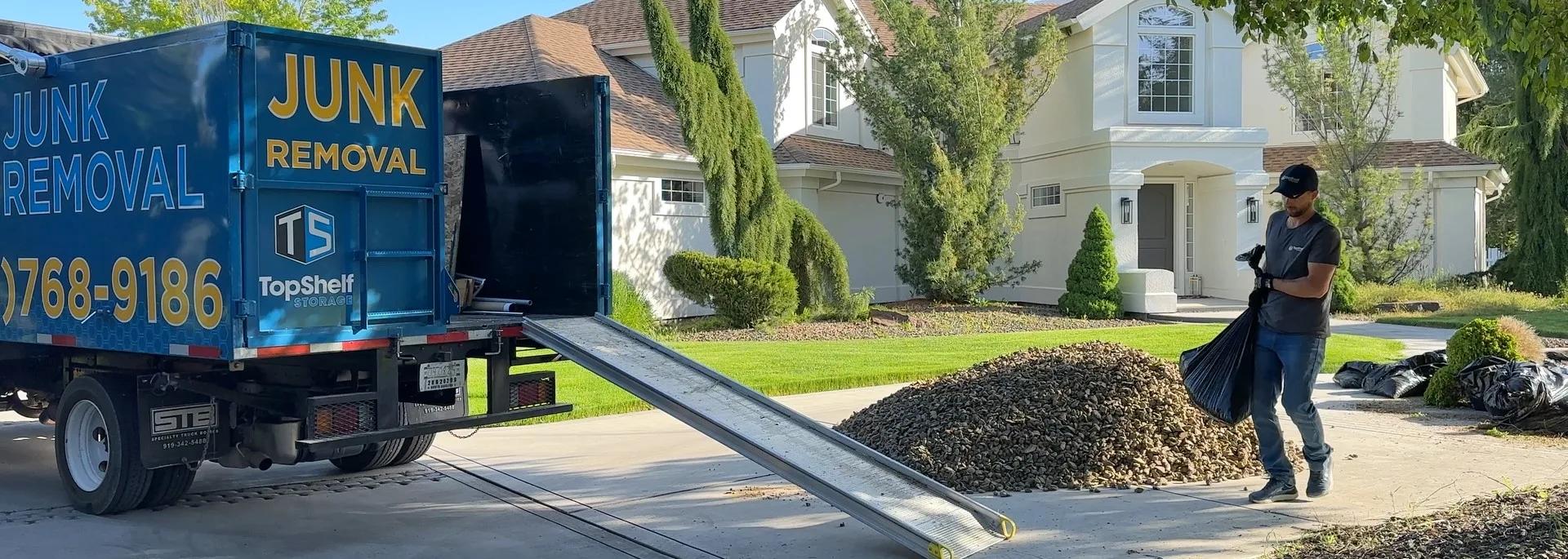
The value of professional junk removal isn't bigger trucks or stronger guys. It's that a drawn-out project can turn into a single visit. You point, the crew loads, and it's done. No figuring out mattress disposal, no loading heavy furniture and no repeat trips to the dump.
Appliance removal is part of that, so an old washer or fridge goes out with everything else.
What moves the cost up or down? Mostly volume, weight, how easy the stuff is to reach and what kind of disposal it needs.
Heads up: Medical waste and sharps can't go on the truck. Set those aside to handle yourself before the crew arrives.
What changes once the stuff is gone?
Sleep can come easier. Not always because the bedroom is cleaner, but because that background noise of "I should deal with all that stuff" just... stops.
You feel lighter. Sounds like hippie talk until you try it. The weight of your stuff isn't just physical.
A calmer home environment is easier to keep. It's easier to spot new stuff when it starts stacking up, and easier to stay content with what you have when you can actually see it.
Your stuff is not who you are. Your memories don't live in objects, and the things you own are supposed to serve you. When they stop serving you, they start draining you.
If you'd rather hand off the heavy part, call for a free estimate and see what it would take before you decide anything.
Frequently asked questions
Why is everything in my life falling apart?
Usually it's several small stressors stacking up, not one big failure. Clearing one of them, like a packed garage, frees up attention for the rest.
Do I need to sort everything before junk removal?
No. Set aside anything you're keeping and pull out important papers and photos. Then point out what goes and what stays.
How do I keep the pile from coming back?
Related reading: Junk Removal Boise: Washer and Dryer Household Junk Haul Away and Garage Junk Removal Boise: Getting Rid of That Dead Freezer.
Give everything you keep a home and decide where new things go before they come in. Staying ahead mostly means deciding while the decision is still small.
Ready to Clear Out the Clutter?
We'll haul it away so you don't have to. Free estimates, same-day service available.
More From Our Blog
What Is the Cheapest Way to Get Rid of Junk Once You Count Your Time?
What is the cheapest way to get rid of junk? Use free donation, curbside and scrap options first, then compare the real cost of hauling the rest.
Mulch Removal Services in Boise: When and How to Clear Old Beds
Mulch removal services explained: when old mulch needs to come out, how to get rid of it, what's involved and what moves the cost up or down in Boise.
Racking Removal in Meridian: What the Job Includes and What Drives Cost
Racking removal in Meridian: what the crew handles, how the teardown and anchor removal work, where the steel goes, and what makes it cost more or less.
